
Document
Heritage Statement
Identifies the heritage assets a scheme affects, explains what makes each of them significant, and assesses honestly what your proposal would do to that significance.
- The tier this usually sits in
- HouseholderThe tier this usually sits in
- Wren, for a case at that tier
- £499Wren, for a case at that tier
- Specimen you can read in full
- PublishedSpecimen you can read in full
- Sections inside it
- 6Sections inside it
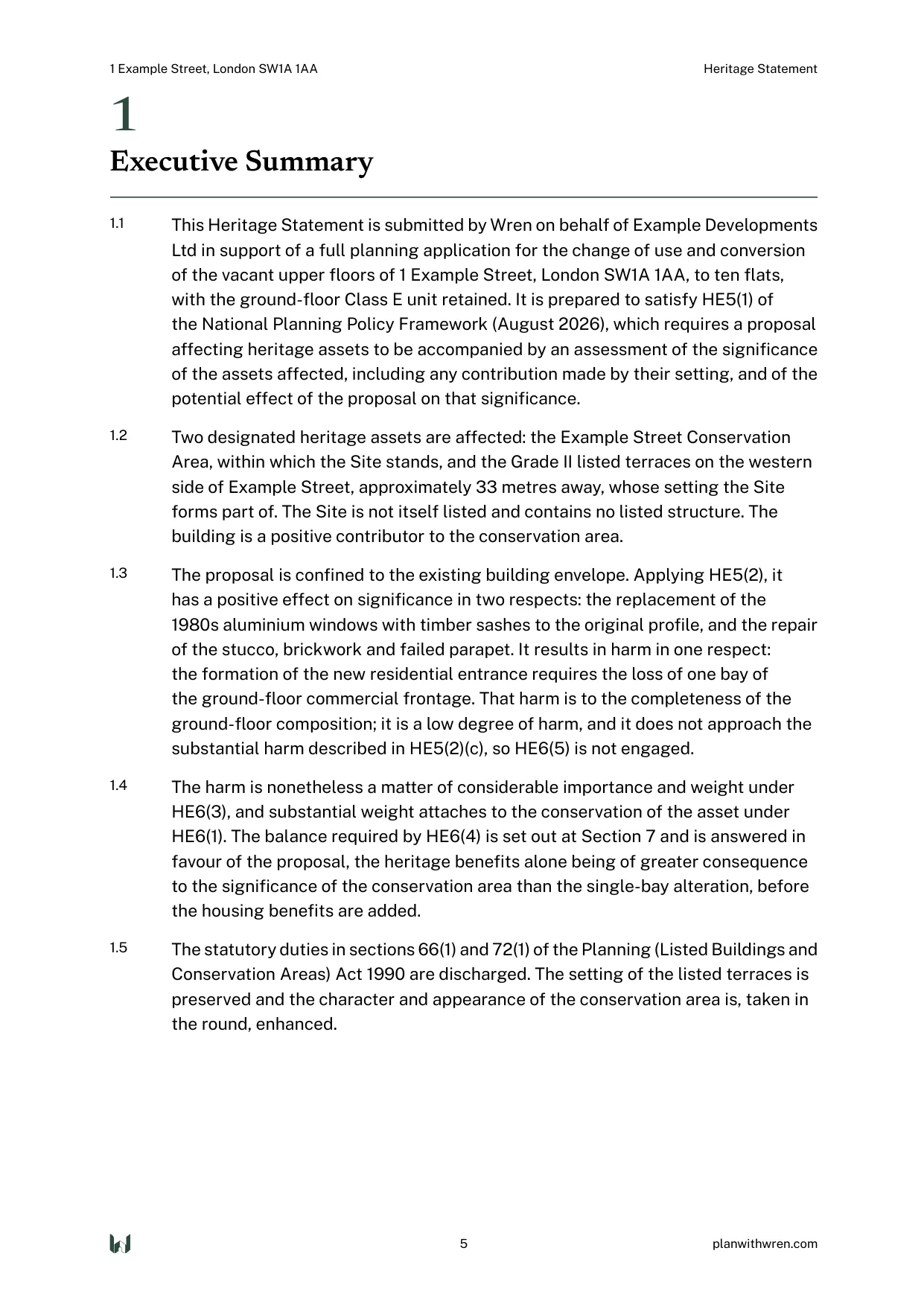
What is inside
Section by section.
- 01Which heritage assets are affected, designated and undesignated
- 02A statement of significance for each one
- 03The impact of the proposal on that significance, proportionate to how important the asset is
- 04Whether the proposal has a positive effect on significance, no effect, or causes harm — and, where there is harm, the degree of that harm
- 05The public benefits weighed against any harm
- 06How harm has been avoided, reduced or mitigated
When it is required
Why a council asks for this.
Sections 66 and 72 of the Planning (Listed Buildings and Conservation Areas) Act 1990 place duties on the decision-maker. Listed building entries are checked against the National Heritage List for England: the entry number, the grade and the name must all match the live record before a citation is allowed through.
| Required when |
|---|
| Any work to a listed building |
| Development in a conservation area |
| Development within the setting of a listed building, scheduled monument or registered park |
| Sites with archaeological potential |
Why it exists
Documents answer constraints.
A council does not ask for this because it likes paperwork. It asks because something on or near your site triggers it, and the appraisal will tell you whether yours is triggered before you pay for anything.
Asked and answered
About the Heritage Statement.
My house is in a conservation area but is not listed. Do I need one?
How do you know what my listed building's entry says?
Often alongside
Documents that usually travel with it.
The main written case for a planning application. It describes the site and the proposal, then argues the scheme against the policies your council will actually decide it under.
Proves that something you have built, or intend to build, is lawful and needs no planning permission. It is a certificate of fact, not a judgement of merit.
For development that is already permitted in principle, but where the council still gets a say on specific matters. Larger extensions and office-to-residential conversions are the common ones.
Submitted after permission is granted, to satisfy the conditions attached to it. Most permissions cannot be built out until these are cleared.
Find out whether your site needs one.
The appraisal names the route, lists the documents that route requires, and prices the set before you commit to anything.