
Document
Planning Statement
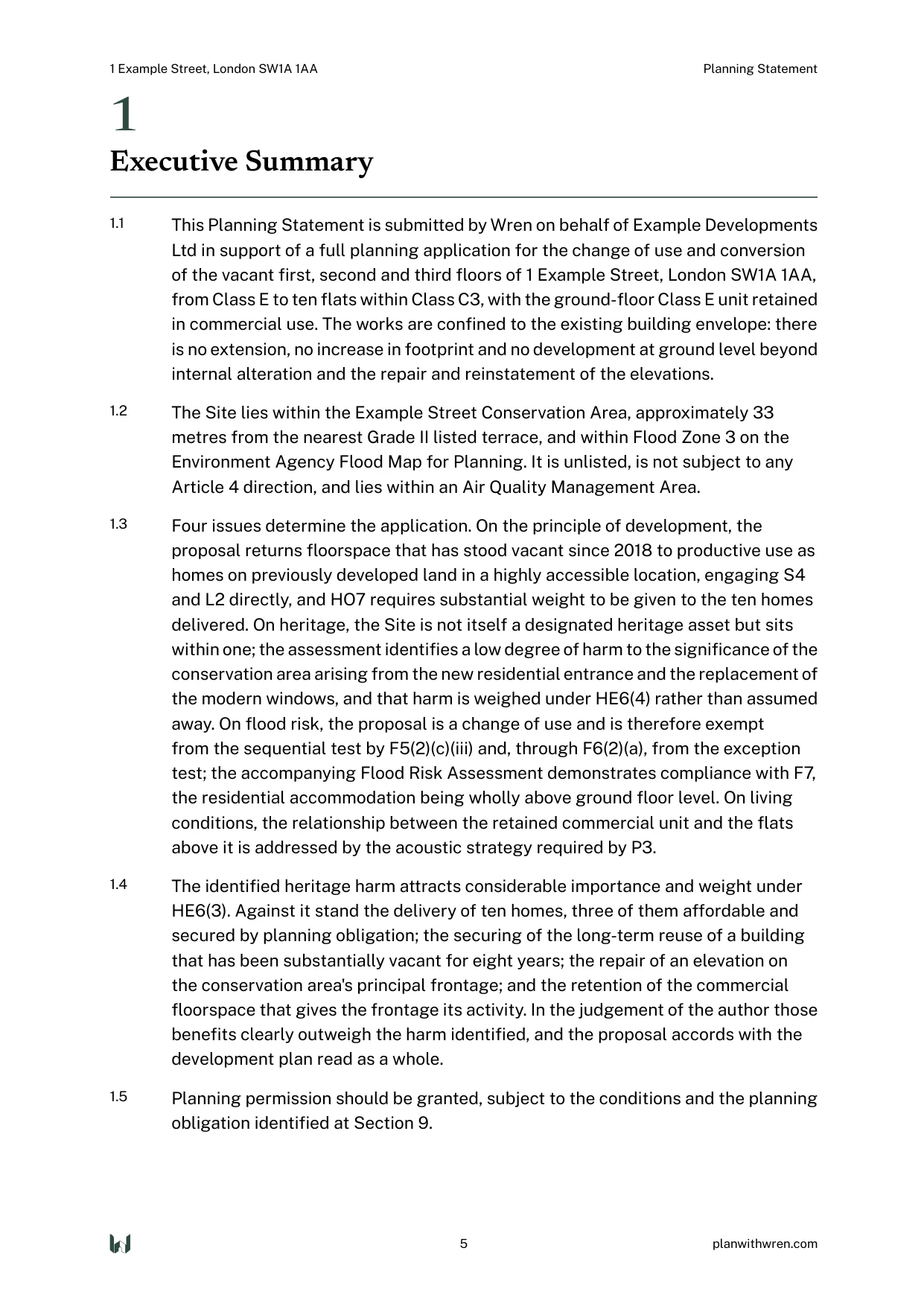
The main written case for a planning application. It describes the site and the proposal, then argues the scheme against the policies your council will actually decide it under.
- The tier this usually sits in
- HouseholderThe tier this usually sits in
- Wren, for a case at that tier
- £499Wren, for a case at that tier
- Specimen you can read in full
- PublishedSpecimen you can read in full
- Sections inside it
- 8Sections inside it
What is inside
Section by section.
- 01Introduction and a summary of what is proposed
- 02The site as it is, and the context around it
- 03Planning history at the site and nearby, with references
- 04The proposal in detail
- 05The policy framework: your council's adopted plan, and the national framework above it
- 06The assessment, issue by issue, against each policy that governs
- 07Community Infrastructure Levy, where the council charges it
- 08Conclusion
When it is required
Why a council asks for this.
Section 38(6) of the Planning and Compulsory Purchase Act 2004 requires an application to be determined in accordance with the development plan unless material considerations indicate otherwise. This is the document that engages with it.
| Required when |
|---|
| Almost every application that is not a bare householder extension |
| Any scheme where the council's validation list asks for a supporting statement |
| Any scheme where the principle of development is arguable |
Why it exists
Documents answer constraints.
A council does not ask for this because it likes paperwork. It asks because something on or near your site triggers it, and the appraisal will tell you whether yours is triggered before you pay for anything.
Asked and answered
About the Planning Statement.
Do I need a Planning Statement for a house extension?
Who writes it?
Are the policies real?
Often alongside
Documents that usually travel with it.
Identifies the heritage assets a scheme affects, explains what makes each of them significant, and assesses honestly what your proposal would do to that significance.
Proves that something you have built, or intend to build, is lawful and needs no planning permission. It is a certificate of fact, not a judgement of merit.
For development that is already permitted in principle, but where the council still gets a say on specific matters. Larger extensions and office-to-residential conversions are the common ones.
Submitted after permission is granted, to satisfy the conditions attached to it. Most permissions cannot be built out until these are cleared.
Find out whether your site needs one.
The appraisal names the route, lists the documents that route requires, and prices the set before you commit to anything.